Caregiving demands incredible energy, but understanding government healthcare benefits can be stressful. In my line of work, I meet a lot of people who don’t know the differences and nuances between various state and federal support systems. One of the most common questions families ask is: what is the difference between Medicare and Medicaid? So, , I wanted to provide some clear guidance to make things easier for you.
Below is your beginner’s guide to understanding the distinct roles of Medicare and Medicaid, exploring dual eligibility, and Medicaid-funded programs. I also address some common questions. Note that policy guidelines change periodically, you should always verify specific state eligibility rules on official government websites ending in .gov.
Medicare vs Medicaid
Although both Medicare and Medicaid provide government health insurance, they serve entirely different primary populations and offer distinct long-term care coverage.
- Medicare functions as a federal entitlement program for seniors aged 65 and older or individuals with qualifying disabilities, regardless of income. Moreover, it acts like traditional medical insurance by focusing primarily on hospitalizations, doctor visits, and short-term rehabilitation. However, Medicare does not pay for long-term custodial care or ongoing non-medical home care.
- Medicaid operates as a joint federal and state assistance program based strictly on financial need. Furthermore, state agencies manage Medicaid locally, which means eligibility limits vary across state lines. Crucially, Medicaid serves as the primary funding source for long-term care in the United States, covering personal care aides, adult day programs, and extended nursing care.
Medicare and Medicaid:Comparison & Overlap
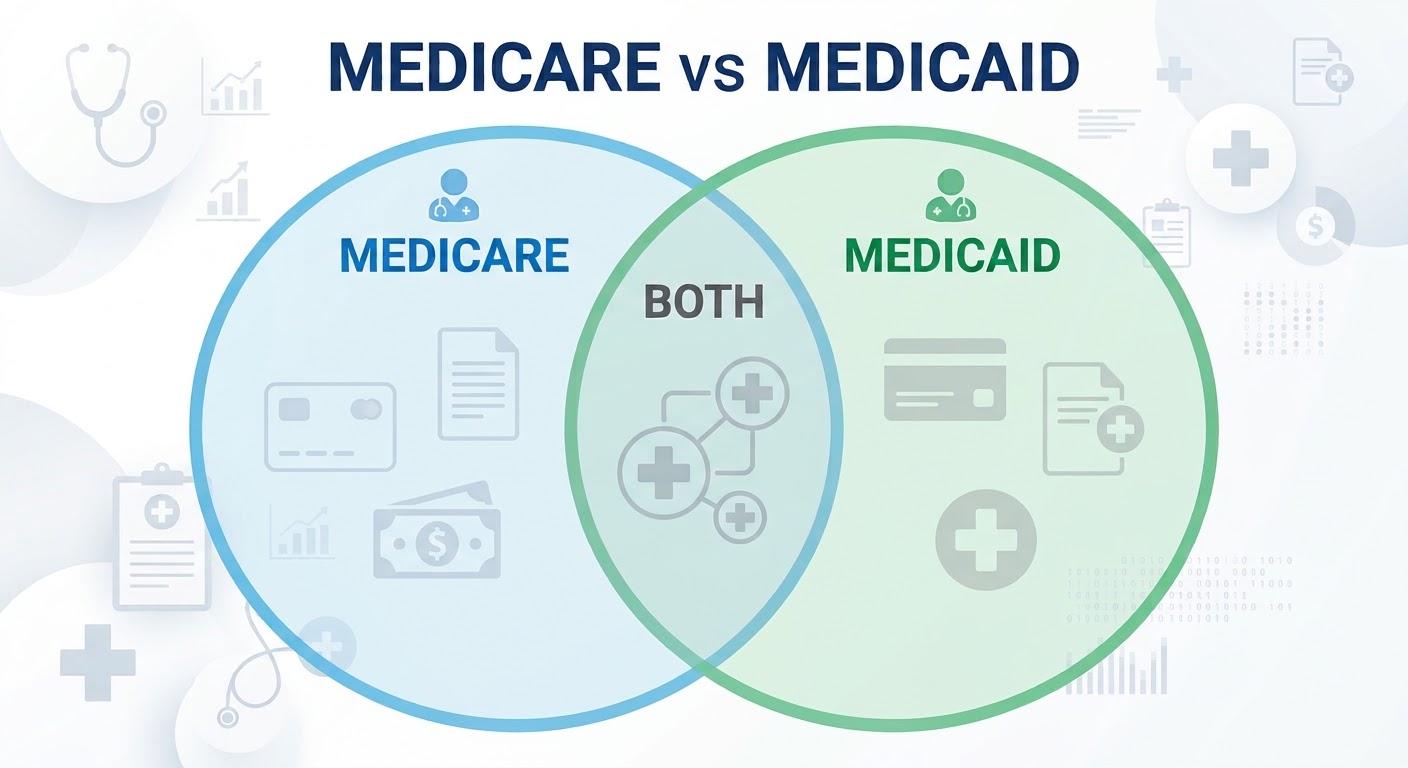
To help you visualize what the difference is between Medicare and Medicaid, the chart below outlines their distinct operational roles and shows where coverage overlaps for “dual-eligible” individuals.
| Feature | Medicare Coverage | Medicaid Coverage | Overlap (Dual-Eligible) |
| Eligibility | Covers age 65+ or SSDI disability. | Supports low-income individuals and families. | Enrolls individuals who meet both age/disability and low-income rules. |
| Long-Term Care | Limits coverage to short rehab stays. | Provides comprehensive home and custodial care. | Fills long-term care gaps that Medicare leaves behind. |
| Caregiver Pay | Excludes paid family caregiving. | Funds self-directed paid caregiver choices. | Compensates eligible family members for caregiving duties. |
| Administration | Operates under uniform federal rules. | Runs through individual state programs. | Connects your Medicare and Medicaid benefits through special state-level plans (called D-SNPs) |
Medicaid-Funded Programs & Waivers for Families
State Medicaid programs, Home and Community-Based Services (HCBS) waivers, and Early and Periodic Screening, Diagnostic, and Treatment (EPSDT) mandates directly finance these essential supports to reduce caregiver burnout.
Caregiver & In-Home Waivers
- Paid Family Caregiving: Medicaid.gov Self-Directed Services — Allows eligible Medicaid beneficiaries to hire and pay family members as personal care aides.
- State HCBS Waivers: Medicaid.gov State HCBS Waivers Overview — Provides state waiver funds for home health aides, environmental safety modifications, and daily hygiene care.
- Long-Term Services & Supports: Medicaid.gov LTSS Overview — Delivers comprehensive daily assistance, personal emergency response systems, and residential care funding.
Youth & Neurodivergence Services
- Childhood EPSDT Benefits: Medicaid.gov EPSDT Guidance — Mandates full coverage for medically necessary therapies, including Applied Behavior Analysis (ABA), physical therapy, and speech therapy for youth under age 21.
- Pediatric Home Care Waivers: Medicaid.gov HCBS Programs — Funds specialized private-duty nursing, home respite care, and adaptive equipment for children with complex medical needs.
Senior & Institutional Care
- Nursing Facility Coverage: CMS Nursing Home Coverage Guidelines — Covers 24-hour skilled nursing, custodial care, and room and board for qualified individuals in state-certified nursing facilities.
10 Frequently Asked Questions About Medicare and Medicaid
1. Does Medicare cover home health care, and what are the strict stipulations?
Yes, Medicare Part A and/or Part B will cover medically necessary home health services, but only under strict criteria:
- Doctor Certification: A licensed physician must certify that the patient is homebound and requires skilled care.
- Skilled Care Requirement: The patient must need intermittent skilled nursing care, physical therapy, speech-language therapy, or ongoing occupational therapy.
- Homebound Status: The individual must have a condition that makes leaving home difficult and requires a taxing effort or physical assistance.
- Important Caveat: Medicare does NOT cover 24-hour home care, meal delivery, or standalone personal care aides (bathing, dressing, meal prep) if skilled medical care is not also required.
2. Can I get paid to be a caregiver for my family member through Medicare?
No, Medicare does not pay family members for caregiving duties under any circumstances. However, Medicaid offers self-directed personal care programs (such as Structured Family Caregiving or Cash and Counseling waivers) that allow qualified beneficiaries to hire family members as paid caregivers.
3. What does it mean to be “Dual-Eligible” for both Medicare and Medicaid?
Dual eligibility occurs when an individual qualifies for Medicare based on age or disability while simultaneously meeting Medicaid’s income and asset criteria. Consequently, Medicaid acts as secondary insurance, covering Medicare deductibles, copays, prescription drug costs, and long-term custodial care services.
4. How do income limits affect Medicaid eligibility for long-term care?
Because Medicaid relies on financial need, states set strict income and asset limits (often around $2,000 in countable assets for an individual). However, special long-term care waivers allow individuals with higher medical costs or moderate income to qualify through “spend-down” programs or Miller Trusts.
5. Will Medicare or Medicaid cover a stay in an assisted living facility?
Medicare never covers room and board in assisted living facilities. Conversely, certain state Medicaid Home and Community-Based Services (HCBS) waivers will help pay for personal care services inside an assisted living community, although room and board fees remain the resident’s responsibility.
6. Does Medicare cover 100% of nursing home costs?
Medicare only covers short-term stays in a skilled nursing facility (SNF) following a qualifying 3-day inpatient hospital stay. Specifically, Medicare covers 100% of costs for days 1–20 and partial costs for days 21–100. After day 100, Medicare coverage ends entirely. In contrast, Medicaid covers long-term nursing home care indefinitely for eligible individuals.
7. How do I apply for Medicaid caregiver support programs in my state?
First, contact your local Area Agency on Aging (AAA) or state Department of Human Services. Furthermore, you can visit Medicaid.gov to locate your state’s specific Home and Community-Based Services (HCBS) waiver portal and schedule an in-home assessment.
8. What is the Medicaid “look-back” period for long-term care coverage?
When applying for Medicaid long-term care benefits, states review asset transfers over the previous 5 years (3 years in California). Therefore, transferring money or property to family members below fair market value during this window can trigger a temporary penalty period of ineligibility.
9. Can children with special needs qualify for Medicaid even if their parents earn too much money?
Yes, many states offer Katie Beckett waivers (or institutional deeming waivers). These specialized Medicaid programs disregard parental income when determining eligibility for children under 18 with severe medical needs, allowing them to receive home-based care.
10. Does Medicare or Medicaid cover respite care for exhausted family caregivers?
Medicare Part A covers inpatient respite care for up to 5 consecutive days, but only for individuals enrolled in Medicare Hospice Care. Alternatively, state Medicaid HCBS waivers routinely fund both in-home and facility-based respite care to give primary caregivers routine breaks